Saturday, 31 March 2018

Friday, 30 March 2018
Little Nemo in Slumberland
Both Kerry Ann and Caroline mentioned I should look at Winsor McCay's Little Nemo In Slumberland as a good historical comic artist who did interesting things with the medium.
Wikipedia says "Little Nemo in Slumberland—a fantasy strip in an Art Nouveau style about a young boy and his adventurous dreams. The strip demonstrated McCay's strong graphic sense and mastery of color and linear perspective. McCay experimented with the formal elements of the comic strip page, arranging and sizing panels to increase impact and enhance the narrative."
Wikipedia says "Little Nemo in Slumberland—a fantasy strip in an Art Nouveau style about a young boy and his adventurous dreams. The strip demonstrated McCay's strong graphic sense and mastery of color and linear perspective. McCay experimented with the formal elements of the comic strip page, arranging and sizing panels to increase impact and enhance the narrative."
The way he played with the standard comic page format to change timing and pacing, as well as enhance the fantastical nature of Slumberland.
I like how, because they were single pages (in the newspaper) they're simple standalone stories, in which he always wakes up in the end, but if you read them in order they actually follow a much longer story which connects together.
I like how, because they were single pages (in the newspaper) they're simple standalone stories, in which he always wakes up in the end, but if you read them in order they actually follow a much longer story which connects together.
I found these two good places online to read them:
And also got out this book, which has some interesting things. Will put up notes later.


I went through and found some interesting pages:


I was also specifically looking for examples which I thought I could adapt for the web - the mushroom one caught my eye as something that would work well in a long scrolling infinite canvas, to emphasize the tall forest and falling.
Tuesday, 27 March 2018
-testing out a new parallax thing, more simple and uses the entire screen.
-I made a simple version of a possible transition page for my comic. I've found that putting the 'sketch' straight into the parallax is easier to get things to line up than the way I did with my other parallax test initially.
-and now seeing if I can upload this into a tumblr custom page to host it, as I want to do because I hope to use this as an actual page in my comic. I couldn't get the parallax to work, but eventually realised because I had the javascript links after the place where it calls for it. The page is here! and still a work in progress at this point

some good links to help with code stuff I came across on tumblr:
http://watercolourfey.tumblr.com/private/172822747982/tumblr_o8u8dnqUQe1ujcqse
https://www.pitiya.com/add-custom-css-javascript-code-to-tumblr-blog.html
https://www.templatemonster.com/blog/integrate-static-html-wordpress/
Monday, 26 March 2018
Saturday, 24 March 2018
Talking to Kerry Ann and Caroline
I talked to Kerry Ann after class
She suggested a few things, including
I also talked to Caroline in Illustration Studio, because I heard her mention Little Nemo as well. She suggested some things
She suggested a few things, including
- Looking at my work in relation to another artist, compare/contrast my work in regards to
- how they work, their contexts compared to mine, how/why they work
- A comparison between me, a contemporary, and historical comic artist
- I'm not sure how well that'd work since I don't realllly have a lot of comic work of my own? I have my single webcomic and the one I did for sequential art, that's all
- Though in general looking at the contexts of historical artists is important
- Maybe talking to a contemporary comic artist, like Toby Morris, and something about my final work being about a 'conversation', which is an interesting idea
- Or just somehow my final comic being about the links of storytelling on the internet
- Create a strong case for my research, figure out thematic links, why it's important, visual storytelling etc
- Suggested looking at Winsor McCay, especially his Little Nemo in Slumberland comic.
I also talked to Caroline in Illustration Studio, because I heard her mention Little Nemo as well. She suggested some things
- There's a lot in the scope, figure out which part of it is important to me and focus on that
- Look at historical stuff, all the way back to trajan's column
- Why it's important - visual literacy
- Suggested also Moebius as another artist similar to McCay
- Look at what the medium allows
- in practice, as the artist what can you do to enhance the storytelling
- and for the audience, making it more accessible, immersive, etc
- Look up interactivity and multimodal media - print books are multimodal (text+image), web allows you to bring even more into that
- What are comics, what do they do? They started off as something subversive and became more acceptable and normal
- Maybe adapt an existing comic into a web format?
TO DO FOR WEEK 6/7
What have you done to date?
- Research
- Javascript tutorials
- tried that parallax demo
Goals for week 6
- Make some test comics
- an infinite canvas one
- a parallax one for mistlands
- look more in depth into a historical artist
- learn more coding things
- some more javascript
- adding scroll activated animation, or a scroll path like that one TBC episode
- Figure out how to get my tests online
///////
From stream:
SET SPECIFIC GOALS AND TARGETS ON TIMELINE
Present how you've achieved these goals ( or if not, what prevented you from achieving the goals? did you find , for example that you need to learn to say, video edit? Did you need to run through the ethics questionare?
Week 6 - second showing
In week 6 we want you to show us what you've researched and how you've researched it. You will have an A1 area in which to do this ( venue TBC), this discursive piece may take the form of a poster, projection, video, AR/VR experience....etc (book any technical things you need)
The aim of this is to show in an A1 area how you contextualise your project, (what or who else is out there and how did this inform your thinking?) What themes emerged, how you have synthesised what you've done so far, articulate what insights your design research methods revealed, who have you read/looked at and how has this impacted on your project? What do you see as your next steps.
- "I've done 'x' and this is what I found out....My next step is to.....This will be achieved through building on/extending the work of/challenging ideas of/disrupting/adding too the design of/being critical of......through........in the context of......"
Week 7 - collaboration
Dossier doesn't have to be physical - make it dynamic! online! interesting!
Thursday, 22 March 2018
Other parallax plugins
Single page, reacts to tilting screen or mouse
reacts to mouse moving
reacts to scroll position
horizontal scrolling (most similar to hobolobo)
/////
this also could be useful: https://css-tricks.com/introducing-css-scroll-snap-points/
reacts to mouse moving
reacts to scroll position
horizontal scrolling (most similar to hobolobo)
/////
this also could be useful: https://css-tricks.com/introducing-css-scroll-snap-points/
Different methods of using the web for comic & the types of story they tell
To extend or emphasise the storytelling (scale or time) - Infinite canvas
To extend or emphasise the storytelling (scale or time) - Infinite canvas
- To show depth or scale of the setting of the comic (eg. falling down, or walking along)
- to show time - more breathing space between panels to space the whole thing out time-wise (always human)
- to show drama - eg something breaking out of the panels to fill the whole screen
- in more normal cases, it's the natural way to read on the web and makes it easier
To hide extra pieces of story/world/character for readers to find/interact with
- clicking around like margot's room, non-linear storytelling,finding out more and more deeper info
- finding out more worldbuilding and secrets -eg instagram map
- things can also be hidden behind the layers with parallax
Monday, 19 March 2018
User story for the form
As an illustrator I want to explore web-comics / graphic-novels / digital-storytelling / interactivity / transmedia so that I can tell stories in new and interesting ways
Sunday, 18 March 2018
Spurgeon, Tom, et al. The Comics Journal Library 5: Classic Comics Illustrators. Fantagraphics, 2005.
Abate, Michelle Ann, and Gwen Athene
Tarbox. Graphic Novels for Children and Young Adults : A Collection of Critical
Essays. University Press of Mississippi, 2017.
Notes under cut
I have more pages I scanned but these are all typed out since it's a physical book
Saturday, 17 March 2018
Always Human / Aerial Magic
Always Human is a nice example of a webcomic which uses vertical infinite canvas (as many webcomics do these days, on platforms like tapastic and webtoon) which is a) for ease of use, scrolling down is natural on computers and mobile devices, but also b) is really makes use of space, giving it a slow pace and a lot of atmosphere and emotion (which suits it, as a romance, as well as the futuristic setting)
The fact that the episodes are fairly long, and take at least a few minutes to read, means that you get much more engaged in reading it, rather than just reading a single page as it comes out each week, like many webcomics (including my own).


/////


(I've come back and added this video after I did it for Circuits and Veins, as it's much more effective in showing the comic aside from going to the link yourself - and I just recently got a smartphone which allows me to do this (and also read them on mobile in the first place))
Another nice thing, which sites like webtoon and tapastic allow, is to add background music. This has the potential to be annoying if people add any random thing, but Ari composes her own music for each episode, which adds to the mood. (i forgot to unmute it for the above video, but it's on the one below
Her other comic, which just started, is called Aerial Magic and is very similar, stylisticly and technically, and just as good so far
The fact that the episodes are fairly long, and take at least a few minutes to read, means that you get much more engaged in reading it, rather than just reading a single page as it comes out each week, like many webcomics (including my own).
/////
(I've come back and added this video after I did it for Circuits and Veins, as it's much more effective in showing the comic aside from going to the link yourself - and I just recently got a smartphone which allows me to do this (and also read them on mobile in the first place))
Another nice thing, which sites like webtoon and tapastic allow, is to add background music. This has the potential to be annoying if people add any random thing, but Ari composes her own music for each episode, which adds to the mood. (i forgot to unmute it for the above video, but it's on the one below
Her other comic, which just started, is called Aerial Magic and is very similar, stylisticly and technically, and just as good so far
Friday, 16 March 2018
First showing
I showed people a bunch of examples and watched their reactions, what they like, and talked to them about it.
The examples I brought up on the screen were my parallax test (with the original comic on another tab behind it), a To Be Continued infinite canvas page, Lights' Skin&Earth Instagram map, Margot's Room and a character twitter account. (will refer to as: parallax, TBC, S&E, MR, twitter)
Some things I noticed:

The examples I brought up on the screen were my parallax test (with the original comic on another tab behind it), a To Be Continued infinite canvas page, Lights' Skin&Earth Instagram map, Margot's Room and a character twitter account. (will refer to as: parallax, TBC, S&E, MR, twitter)
Some things I noticed:
- Some people were mostly interested in the parallax and TBC. One person in particular commented on how they like the movement, and how you scroll to reveal more of the story, it's very dynamic. He was more interested in the dynamism of the main story as opposed to S&E and MR where you have to click around and discover things (he said that those were't particularly interesting to him).
- Whereas some people absolutely loved S&E, thought it's very cool and kept saying "wow! wow!!" when I showed them how it led to other accounts/maps. Some people talked about how they love to explore extra things like worldbuilding through maps, or to find little extra nuggets of things when you explore something more.
- People's reactions when they scrolled the parallax and suddenly noticed the different layers, or when TBC suddenly changes scrolling angles was interesting (usually they exclaimed out loud)
- With the parallax (the original version, not just mine) and TBC, some people read it properly and some just scrolled back and forth exclaiming about how cool it was.
- Therefore something like that needs to have very strong visual storytelling and not rely on the text. Also would probably suit shorter comics that you read in one go rather than long things? If you're not invested in the story you're unlikely to come back to it every update. For example, I think TBC is really cool but I haven't read past season one because I don't actually care about the characters or story, (and only read half the text of what I did read)
- Although I think there is also a point to be made that something that looks cool and is fun to play with and nothing else isn't necessarily a bad thing! It's just in terms of what kind of narrative/storytelling is intended
- I had an interesting conversation with Kezia about that - that there needs to be a mixture of good art, good format and good plot/characters to keep people interested in a comic. Doing fancy web things may bring in viewers but won't keep them if it doesn't work with the rest of the story
- We also talked about the concept of medium of storytelling being determined by necessity - some of the research I've been doing talks about [when adding things makes something other than a comic - if adding some sound effects or animation enhances it, surely it'd be better as a full animation?] but Kezia pointed out that people may not have the time/money/skills to do that, therefore they only add the little bits of it.
- Talked to someone who said what they liked about all the examples was the interactivity - and it really draws you into the story. We also talked a lot about how the different methods work for telling different types of stories.
- also talked about the ambiguity of these comics and where they become games/animations/etc and how that's a good thing, and that in the end it doesn't matter what type of thing it is if it's an interesting & engaging story
- i think specifically in regards to interactivity in comics - it's something you don't necessarily expect going into it? whereas when you go into a game you expect to interact with it


Who ( is it for) - I'm looking primarily at the kind of webcomics I read, of which the audience tends to be a millenial kind of audience - or late teens through to 30-something. Also generally lgbtq+, diverse in other ways, and sci-fi/fantasy
What ( is it about/does it address/do I need to find out) - how the different methods are used to tell different kinds of stories, how to actually do it (coding, hosting on web, etc)
Why ( is it needed/important/neglected) - Storytelling is important? And finding new and innovative ways of doing it is good
How ( what process,methods will you use) - web/digital comics
When ( a provisional time line)
Thursday, 15 March 2018
Library books

Experimenting with social media storytelling?
I have my own webcomic, Mistlands. There are only two chapters so far (I'm working on ch03 but it's slowed down since I've started back at uni). When I started out I'd never made a comic before, and opted to go with what's essentially a print comic uploaded to the web - normal a4(ish) pages, static, etc. This is because it seemed easiest, and also I do want to print it someday when it's done. I think that's the reason a lot of webcomics are in page format - they want to have the option for printed editions. As a fan of webcomics, I'd like to buy physical copies after I've read them, as it's easier to read in book format all at once, and it's nice to support the creators in that way - I've only actually bought a few because they generally have very expensive shipping, as something that's generally published and distributed by the artists themselves.
I've been thinking about making social media accounts for some of the characters since the concept stage, but haven't properly yet - a month or so ago I made Talia an instagram account:

It's locked at the moment, and I've been posting various random photos and drawings (she's an artist/photographer). My idea is to fill it up with that sort of thing, which will all be set before the comic starts, and then when the end of chapter 3 goes public start to change things - because at in ch01 Talia gets kidnapped by a faery, who basically takes her to a place where she keeps artists, and enchants them to create forever, and the plot of the first three chapters is about rescuing her (among other things). When she gets back home she has a kind of artist's block/ptsd, where she can't create because nothing's as good as what she made there/it brings back bad memories, that kind of thing - and I want to show that in her social media, among other plot elements.
Unfortunately, I can't really test the effects/reactions of that for this paper since I haven't really drawn chapter three yet, so can't set that part in motion. I will launch the account soon, though?
I also want to make tumblr and/or twitter accounts for Esther and Leela, the other two main (human) characters, though I don't want to overdo it straight away. (actually, I have made Es a tumblr (password: esther), but have just reblogged a handful of things on it. I may write actual text posts for her, but have no specific plans at this point in time)
---
Something else I was thinking I could do, is to make a couple of the pages in ch03 parallax, or infinite canvas. There's some scenes where they're walking through the forest, (also riding horses through the forest) which I think could be enhanced by using those things - I just don't know if that's something I'll be able to do in the time of this paper.
Wednesday, 14 March 2018
More examples
Margot's Room is an interesting comic I found - the start is just one page, with a poem. You click on the objects named in the poem (flowers, wall, blood) and they lead to another page with a comic - which either scroll down or across. The final one scrolls across and down, and ends up leading into the main illustration on the first page. Because you can click on any object in any order, and each comic has a link to the main page, it's a kind of non-linear story. Most of the comics aside from the last one are flashbacks noting certain things in the past that lead up to what happens, so it doesn't really need to be read in the right order.


The Prince & The Sea is another comic by the same artist - which is just 12 pages/panels in the middle of the screen, but then the final one breaks out of it and goes down. It's simple but clever, as all of the first pages are in the same small forest glade with a pool at the bottom - and the final one is the mermaid dragging the prince's body down underwater.


(they don't quite line up here in blogger, but it's only 12 pages and is best viewed on the site at the link above.
The Prince & The Sea is another comic by the same artist - which is just 12 pages/panels in the middle of the screen, but then the final one breaks out of it and goes down. It's simple but clever, as all of the first pages are in the same small forest glade with a pool at the bottom - and the final one is the mermaid dragging the prince's body down underwater.
(they don't quite line up here in blogger, but it's only 12 pages and is best viewed on the site at the link above.
Tuesday, 13 March 2018
Social media as a storytelling device
Some more about social media storytelling. I made a tweet asking for examples of fictional characters' social media and got a few examples! I'm focusing in on comics here, but there are a lot more for other media.
There are a few articles on the subject (not that helpful), but most deal with the type that's based around advertising. Arguably all of these are a form of advertising; having a twitter account in which all the 'photos' are drawn is uncommon and likely to be obvious that it's fictional in some way, and possibly create interest, but I doubt it's that effective; there's far less twitter followers on most of these accounts then there are subscribers of the main comic (if that's public).
It's more of an extra content thing, for fans. Breaking the fourth wall in a way is interesting, especially when the comic is set in, for example, the future, or is sci-fi/fantasy in some way - there's a kind of juxtaposition of that and the fact that the account is 'real'. Another thing which is really effective is the interactibility of it - many of them actually interact with people who reply to the tweets.
I don't really 'talk' to any of the characters below, but I talked to a fair few webseries characters. (I don't watch so many webseries these days) I won't list them here because there are a lot and it's going a bit off topic from the webcomic theme, but most LIW (literary inspired webseries) are very fourth-wall breaking, they're in vlog format and the youtube accounts actually belong to the characters; they talk to the viewers. So most of them have a variety of social media accounts - here's some examples - I tweeted Omar quite a lot because we have similar interests. It's interesting how you're aware that they're a fictional character, but it still feels like you're talking to a real person? And there's a certain thrill to having the character talk to you; it feels like you're part of the story, and gets you even more invested.
There's a TV Tropes page on this called Character Blog. Here's some of the description:
The Character Blog may serve several functions:
- It can provide a new angle to the existing plotline, by writing the story in first-person perspective rather than the omniscient view of the story that the audience usually gets. This can be highly effective if there are blogs for different characters in the same show — The Ditz will probably have a very different take on things from The Smart Guy, for example.
- It can offer supplemental stories, filling in the time that the characters were "off air" or providing relief from the main storyline, such as doing a silly entry or personality when the Canon plotline is rather dark. May also fill in backstory or provide more Character Focus than the canon can afford to provide, or keep the audience informed on a character who is currently Out of Focus or uninvolved in the present rotating arc. This is a popular use of the Character Blog for webcomics, which often don't have the time or space to fit in all the stories an author would like to tell — it's much quicker to write a text entry than to draw a comic.
- It acts as a Fourth-Wall Mail Slot, allowing the fans to interact with the creators, with the alias of the fictional character as an intermediary.
Usually, the Character Blog is seen as positive, a quirky addition that exists between Canon and Fanon; it adds to the story, but isn't mandatory reading.
- Basically, it makes the character seem more real.
Examples
Griefer Belt // Scott's Twitter / Lars' Twitter
Griefer Belt has two main character twitter accounts, which were started up only in the latest few chapters. They're not essential to the story, but have interesting extra details, and help flesh out the characters in ways that aren't generally shown in the comic. They also reply to real people who talk to them
It also shows contrast between the characters - Lars is very social media savvy, whereas Scott obviously is not and barely knows how to use twitter. They're 'real time' in the sense that the tweets happen in relation to the comic pages, though obviously one scene might take three weeks, so the tweets on the twitter timeline will be more spread out.
Project Nought // Mars' Twitter
Project Nought is actually set in 100 years, so he's not tweeting in 'real' time, though as with above, it is in relation to the comic updates. He's also a character who is very social media savvy. An extra level of interactivity with this (and Lars above) is that patrons of the comic can get a selfie with him - in story, they're 'time travellers' (in Griefer Belt, they're Lars' party guests) Patrons of both can also get cameos in the comic itself.
Check Please // Eric's twitter
This is an example in which the tweets are in real time - which means that they're ahead of the comic. - Therefore the account is locked and we can only see archived tweets. This is an example of a more streamlined account which is more directly related to the story. The comic itself is told in 'episodes' which generally start out with the character vlogging, talking to his audience, and though that's not as direct of a 4th-wall-breaking as webseries with actual youtube accounts, it's still something that connects to having a real social media account.
Monika from Doki Doki Literature Club // Twitter
I'm not familiar with this - but after some brief research, it looks like she's the main antagonist of the game which is a visual novel, that seems like a dating sim but is actually a psychological thriller? Which makes use of breaking the fourth wall a lot - therefore giving the character a real twitter account goes along with that theme. The account's only got a handful of tweets from the last year, and doesn't interact with people
Steven Universe // Peridot's twitter
Steven Universe is a kids cartoon about aliens living on earth (kinda), and Peridot is a character who uses a recorder to record diary logs, but it breaks, so Steven gives her a tablet and shows her twitter to use instead (as far as I remember). Her twitter was made when that episode aired, and the tweets are great - it really suits her character to make a lot of all-caps tweets in a way that shows she probably has no idea what she's doing. After that first episode she occasionally tweeted things relevant to new episodes just before they aired, which helps keep it realtime
The Bright Sessions // Caleb's Instagram
The Bright Sessions is a podcast, and some characters have various social media accounts. They're mostly faceless photos as it's an audio medium, and the actors don't look like the characters.
Radio Silence // Colbie's Twitter / Instagram / Wren's Twitter / Shy's Twitter
This is a webcomic I haven't read - but from glancing at the twitter accounts, they seem really realistic, in terms of the random tweets, retweets, commenting on real-world events etc.
Some other things of a similar vein:
Manuel, Dear David, Ver_acity
Dionea House
I haven't looked into this much but apparently it's a story told through emails and blog posts, which branches out into different blogs later on.
Friday, 9 March 2018
Workshops
The first workshop I did was Kerry Ann's; Creative Process, in which we wrote down a whole lot of topics/issues, audiences, contexts, vcd outcomes and creative references; and then used them as a kind of random output. It was very much oriented towards issue-based ideas so not so much useful for me? But I think I will still be having to think of those things

(worksheet for my own reference)


Then I did Research Methods with Tristam, talking about different ways to research. I think it was helpful to look at it from more of the view I'm coming from (researching digital comics, investigating that rather than issues).
Some ways I can research:
- reading/playing things and recording my own (or other people's) reactions to them, how I/they react to it and interact with it
- I will read some digital comics that do interesting things and write about how i interact with them, maybe observe some other people too
- making things, responding to it with my own judgement - the important thing is writing about it!!
Also clarified proposal vs report - proposal is looking into things you find interesting, taking x approach based on what you've discovered; report is starting on an issue and designing for it

BRIDGING THE GUTTER: HYBRID STORYTELLING FOR DIGITAL READERS
Caroline CampbellNovember 17, 2015
Highlighted notes under cut
Thoughts
- I'm interested in the ways comic storytelling has been advanced in the digital medium, both from the technical side (animation, code, parallax, infinite canvas) and human side aka using social media platforms, and how people interact with it
- >> interactivity and making comics more immersive and involving people
- research how comics have changed over time in regards to interactivity, history and development
- 'issue' is storytelling and narrative, application is web technology?
- proposal report
- in terms of what my narrative for when (if) i make a comic for my final thing, I'm interested in something like retelling classic stories with a more diverse cast and inclusive story, making it more modern etc. This also ties into interactivity and immersiveness in terms of making it more accessible to audiences who are not (straight/white/cis/etc)
Thursday, 8 March 2018
Digital Comics: Harder, Better, Faster, Stronger?
by JOSIP BATINICNovember 21st, 2016
highlighted notes under cut
Wednesday, 7 March 2018
Research - reading

This is obviously a slideshow for some presentation, but it seems to be about various types of comic narrative and it's development over time and there's things I can research more into.
This is an article by Caroline Campbell about Josie and the Whales
The others are articles from the library database/google scholar; Rethinking Webomics: Webcomics as a screen based medium by Dennis Kogel and Digital comics - new tools and tropes by Daniel Merlin Goodbrey
Parallax test
I downloaded the code from this tutorial by the person who made the Hobo Lobo of Hamelin - it was a little broken (and there's still some things that are) but I managed to figure it out. Here's a video of it working (somewhat):
Figuring out how to make the art for the different layers took a bit of work as well:

And there are still things I would change probably, in terms of how it works in between the main frames that are pictured above
Research - webcomic/digital storytelling examples
I'm transferring this over from Innovations in illustration (and adding to it a bit) since I'm definitely going in this direction for my research and I'll probably figure something else out for that paper.
First, I just want to link to my sequential art blog from last year, where I have a ton of examples of webcomics I've read - though many are just single pages optimised for print more than web - they're generally webcomics because of the online community and accessibility, not the literal affordances of the medium.
A very short comic which uses infinite canvas, which you have to manually scroll the right way (as opposed to the above comic which scrolls in different directions but you just scroll 'down' the entire time). It starts in panels which get bigger and explode outwards as 'Pup' thinks about how massive the universe is
I really like how this is subtly animated - like a storyboard revealing more bits (panel delivery), rather than actual animation. I actually went to a workshop with him at the library a few years ago where he talked about his process.
The panel delivery is done fairly simply mechanic-wise - every 'page' is actually technically about 4-10 pages, and the whole comic is on the main mothcity.com page, and you use the arrow keys to go through them, so it looks like you're on the same page and things are being added to them. It therefore, has an interesting way of changing the pacing slightly from having one page, then you click/turn to the next page - because you're clicking each time, it's more streamlined - though of course some pages have many separate panel deliveries and some have few.


He also does a nice thing with narration appearing in a panel, then that panel being filled with an image.


This uses vertical infinite canvas, and is viewed full screen - it's mostly in the centre of the screen, simple pixellated lineart, but as the story goes on it explodes out everywhere and uses red tones as well - it's a good example of how the narrative and composition are just as important as Good Art, as I found it super engaging and read all of it in one go (and would read again) unlike the ones above (not that this isn't good art - it's just very simple). A lot of personal preference comes into that too, as all the characters are female and queer which is a reason I'll read a story.

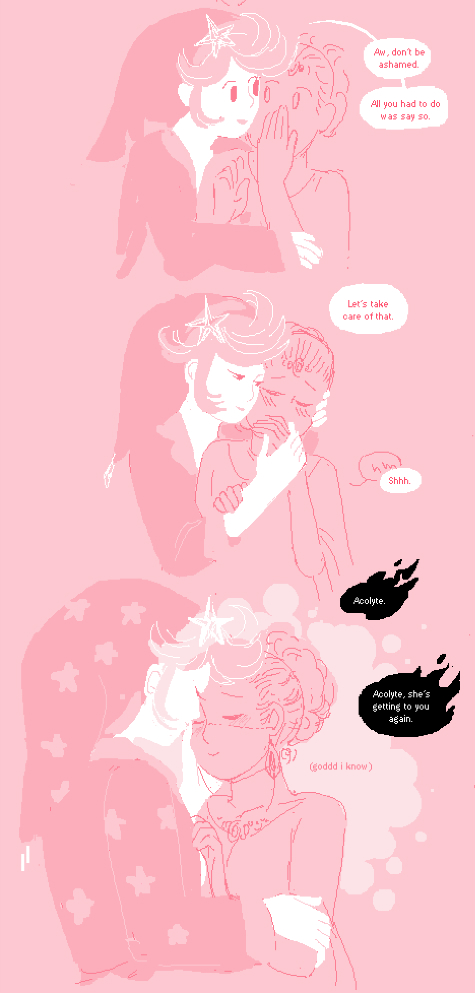


Here are two examples, from the comics Griefer Belt and Project Nought:


Lights is a musician whose most recent album is combined with a comic she wrote and drew - each song corresponds to a chapter, and the music videos are scenes in the comic. Each image has locations which lead to other accounts via the tagging system, and these were slowly unlocked in the build up to the album/comic release. Some have clips of the songs hidden in them, and other bits of worldbuilding and extra content.

Years & Years' album annoucement - which is still ongoing - sets up an automatic thing on messenger which reveals some of the worldbuilding in the dystopian world the album seems to be set in (it's unclear at this point) Because it uses messenger which is alongside your real chats with real people it feels more real somehow, even though it's a fictional.
and it's now shifted to an instagram story (can be viewed in the story highlights). This is more of a promotional thing as far as I know, rather than an actual story but I think it's interesting

First, I just want to link to my sequential art blog from last year, where I have a ton of examples of webcomics I've read - though many are just single pages optimised for print more than web - they're generally webcomics because of the online community and accessibility, not the literal affordances of the medium.
Hobo Lobo of Hamelin
This scrolls sideways and uses parallax and a bit of animation (as well as music) which is really cool! It also has nice colours and sketchy style with lots of contrast. The actual site around it kind of draws away from it though? (background colour, clunky buttons, narration below it) This page is particularly pretty. I love the way the canvas tapers at the end like a brushstroke, too.
Admittedly, I don't really actually read the narration/get too into the story, just scroll through it because it's cool.
The creator also has a page with tutorials and how he's made it.


The creator also has a page with tutorials and how he's made it.
To Be Continued
I haven't read past the first few chapters of this, I just found it searching for webcomics that take advantage of the web - it's interesting in that when you scroll, it starts by going down, but then also goes sideways and diagonally and all sorts of things. In one episode the screen is literally a facebook interface in which you can scroll down the feed and the chat (shown in this article). In another there's an animated video. This episode is a particularly good use of the infinite canvas

Tim Gibson's Moth City
I really like how this is subtly animated - like a storyboard revealing more bits (panel delivery), rather than actual animation. I actually went to a workshop with him at the library a few years ago where he talked about his process.
The panel delivery is done fairly simply mechanic-wise - every 'page' is actually technically about 4-10 pages, and the whole comic is on the main mothcity.com page, and you use the arrow keys to go through them, so it looks like you're on the same page and things are being added to them. It therefore, has an interesting way of changing the pacing slightly from having one page, then you click/turn to the next page - because you're clicking each time, it's more streamlined - though of course some pages have many separate panel deliveries and some have few.
He also does a nice thing with narration appearing in a panel, then that panel being filled with an image.
Lady of the Shard
This uses vertical infinite canvas, and is viewed full screen - it's mostly in the centre of the screen, simple pixellated lineart, but as the story goes on it explodes out everywhere and uses red tones as well - it's a good example of how the narrative and composition are just as important as Good Art, as I found it super engaging and read all of it in one go (and would read again) unlike the ones above (not that this isn't good art - it's just very simple). A lot of personal preference comes into that too, as all the characters are female and queer which is a reason I'll read a story.Josie and the Whales
A comic/ebook with sound and other digital aspects - it's mostly just static illustrations with audio files. I will ask Caroline more about this in class next week probably. She calls it a 'screened book' - it's not technically a webcomic as it's not in that context, and it's aimed for younger audiences and utilizes a lot of audioNever Mind The Bullets
I can't find this online but there's a video at the link. Another example of parallax, though it seems kind of overused in this - or maybe it's just the video format. I think this is relatively old.
Social media as a medium:
Some webcomics (also a lot of webseries) have characters with real social media accounts - this is not generally a part of the main narrative, but something extra that adds details to the character or worlds. It's also a great example of interactivity, as you can "talk" to the characters (even if you're actually talking to the creator)Here are two examples, from the comics Griefer Belt and Project Nought:


People who are Patrons of Project Nought can get a "selfie" with mars.
Lights' Skin&Earth map on instagram

Years & Years' album annoucement - which is still ongoing - sets up an automatic thing on messenger which reveals some of the worldbuilding in the dystopian world the album seems to be set in (it's unclear at this point) Because it uses messenger which is alongside your real chats with real people it feels more real somehow, even though it's a fictional.
and it's now shifted to an instagram story (can be viewed in the story highlights). This is more of a promotional thing as far as I know, rather than an actual story but I think it's interesting

Subscribe to:
Posts (Atom)